
December 30, 2025
How My 2025 Reading (Sub)stacked Up

Less Books
I probably did less book reading this past year than I have in previous years. That’s partly down to how much time and attention has gone into setting up a new life in a new city and still having to do a significant amount of travel for work, even if the air travel time was shorter.
It’s also the year that I started a Substack long-form essay project (more on that in a minute). And it’s been enjoyable following some of the Substacks of writers, whose works I have read in books I have read a LOT of Substack long-form essays this year. And written quite a few too. Substack gives a great IRT exploration of where writers are at in their thinking.
But back to books. Here are five that I have read (or am still reading at the moment with one day to go in the year!). These are all worthy books, though there is no particular order here:
1. Believe: Why Everyone Should Be Religious: Ross Douthat.
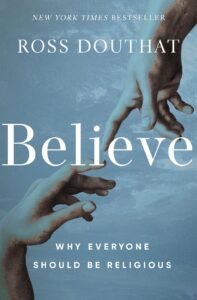
I posted an early review of this in April when I’d just started reading it. Douthat, as a major figure in the secular writing sphere (he’s a regular New York Times columnist and podcaster), is important because he gets to audiences that Christian writers generally do not get to: namely those who need to be convinced, rather than the already convinced. As such, this is a great book that begins expansively, with the conviction that in the West in particular, we are in a meaning and purpose deficit.
Douthat goes on to explain how religion in general is worth a second look, and why it answers many of the questions that the secular West is struggling with. But as a good conservative Catholic he is not content to leave it at that. His last chapters focus in on why he believes the Christian message is the best option. And he concludes with that most anti-Western sentiment:
This too is part of why I believe: because the Jesus of Scripture isn’t always the Savior that my native self finds relatable, the kind of God I would have invented for myself, because there is tension between some of his hardest and most inscrutable sayings and my own personality, my natural intellectual perspective, my instincts and my desires.
In other words, believe, not because God is completely like us – even as a human in Jesus – but primarily because he is not! Counter-intuitive, but that, increasingly, is the reason many younger people are heading towards belief. A worthy read, and written well also, as one would expect from a seasoned commentator.
2. How Christians Can Succeed Today: Reclaiming the Genius of the Early Church: Greg Sheridan
Spot a theme so far? Apologetic books by writers who are both Catholics and are both senior figures in the secular cultural space in journalism, and mainstream media in particular. Sheridan is the Foreign Editor of The Australian newspaper. This is his third book in a trilogy (Trinity?) of books about Christianity.
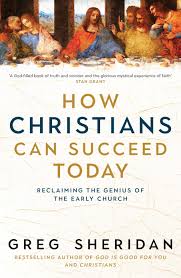 Like Douthat, Sheridan is attempting to convince the secular reader of the compelling claims of the Christian message, and in his case as it is lived out in the lives of those who practice it across the world, and in so many different ways, and through so many different experiences. Some of the tales he tells are harrowing, particularly the awful tragedy of a car crash in Australia that claimed the lives of several young children. He speaks with the parents, Danny and Leila Abdallah, Marionite Catholics, who unpack in the baldest ways, how they were able to forgive the driver of the car, and why the gospel is the only path to forgiveness and recovery.
Sheridan links the central tenets of the modern day saints he interviews, with the early lives of the biblical saints, showing that the genius of the church in impacting the world, is still available today. Once again, he has an eye on a secular audience, and in this age of the Quiet Revival such books are becoming increasingly important. And like Douthat, a great writer.
Over the course of the three books, and by his own admission, Sheridan has become more observant in his faith. Humble brag: I get a mention in the first and third of the trilogy.
3. Strange Religion: How the First Christians Were Weird, Dangerous and Compelling: Nijay Gupta
We’re really onto a theme at the moment! So much apologetics! This book is informative, strongly Christian and a great insight to the extreme strangeness of the Christian message in the pagan world of the time. Much is often made by secular apologists and atheists of how we have gotten rid of all of the gods but one, and now we have to simply get rid of Him (namely the Christian God).
This book accounts for the sticky staying power of the Christian faith. Jesus Christ stands in complete contrast to the other gods, the Greek and Roman gods of antiquity, not merely in his message, but the method and manner of the Christian faith. It lived counter to the pagan frameworks around power, ethics, worship, society, the norms and practices that would keep the world in order.
Christianity was a deep threat to the social fabric. That’s why it was persecuted. But that is why it was so popular! The social fabric was epitomised by deep hierarchy, power structures that favoured the powerful and worship systems that were about performance and not purity, habits and not holiness.
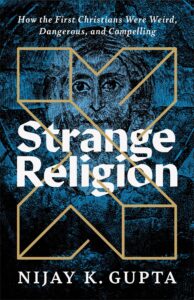
Gupta shows how the Christian message, and particularly that message lived out in ways that cut across the social order in dangers ways, was repellently attractive. He shows how pagan Rome, so concerned and indeed worried about maintaining peace and order, viewed any aberration from the standard worship system as a threat to Rome’s security. Do not make the gods angry!
Yet the gods, eventually, could not stand in the face of this strange, new religion. The promise, according to Gupta, is that while the gospel lived out today in the West will still be viewed as weird and dangerous, it will continue to be compelling to those who have lost their moral, existential and meaning frameworks.
What is interesting about all three authors so far, is that like Douthat, Sheridan and Gupta are at pains to point out that it is the person of Jesus that is the most compelling aspect of Christianity. Gupta calls Christians “Jesus-obsessed” and Sheridan calls them “Jesus-centric”. This is a great reminder that whatever path the faith takes in the West in the coming decade, the surest bet is to focus on Jesus and who he is, and what he said and did. The rest will fall into place.
4. Made In Our Image: God, artificial intelligence and you: Stephen Driscoll
This was deservedly The Australian Christian Book of the Year 2025. At the very time we are experiencing seismic shifts in our technological world with the rapid rise of AI, the bigger questions of what it even means to be human any more have come to the surface. And there is a deep tension here. What is the value of a human being if AI can perform better than we can at many tasks, and even demonstrate a semblance of sentience.
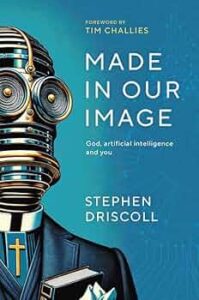
Driscoll’s genius is not simply in how he unpacks how far we have come in the AI world, and the rapid pace of change. It is in dialling down the anxiety for Christians who are dealing with these changes. In fact, we have the armoury in the gospel story of salvation (from creation to new creation) that shows that God’s concern for human beings made in his image means that whatever technology does, the future for humans is assured.
The book is divided up into neat sections that follow a gospel framework and allow time for readers to see the unfolding plan of redemption through the Creation/Fall/Redemption/Restoration grid.
At a time when many futurists and the AI champions of Silicon Valley are breathlessly anticipating how AI will put an end to war, famine, all of the “isms” that affect us, Driscoll shows how, in the biblical story, God has a much bigger and grander story. The eschatological hope of AI cannot compete with the story of a God who becomes one of us, in order to save us not just from our sins, but our deluded hopes that we can save ourselves. In the midst of the churn and anxiety of the AI revolution this is a comforting book.
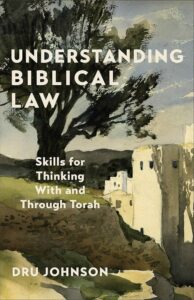
5. Understand Biblical Law: Skills for Thinking With and Through Torah: Dru Johnson
I haven’t finished this book, but have been enjoying it immensely. I met Dru in my recent visit to Israel, and he is a completely likeable character: a rough early upbringing, then part of the punk subculture, a counter narcotics agent in Columbia for eight years, and now, somehow, a Hebraic scholar who works at Wycliffe Hall in Oxford and in Jerusalem, among other places.
The central thesis of his book is that we need to read the Torah afresh through the eyes of the community to which it came, not simply as a set of laws, but as instruction of how to live the life God intended Israel to live so that she might be a witness and a blessing to the nations. As such it is reductionist of us to read it as simply rule-keeping. Of course this has been said before, but the accessibility of this book is striking. Dru has a way of taking the complex and breaking it down into its simple components:
Take this for example, when discussing the oft-lamented sternness of God when dealing with the sin of Israel, which often is an affront to our modern individualistic sensibilities:
The exodus, God’s treaty making at Sinai, Israel’s wandering, and Israel’s settling in Canaan could all be considered justice/righteousness team-building exercises. The Pentateuch’s narrative sections also highlight the fragility of team effort. That fragility of esprit de corps might help explain why God swiftly dealt with egregious transgressions in the team-building phase. Achan’s theft, along with the complicity of his family, so flagrantly goes against everything God has been attempting to do with Israel that God deems it cancerous to the nature of the enterprise. Their immediate excision is the result of the goal: Israel’s justice/righteousness for the sake of the nation.
Some final Substack Thoughts
And now a final word on Substack. Or two words. First: Many writers are finding their way to Substack and posting daily or at least weekly. My favourite is Alan O Noble, though he goes by the more grandiose signature O Alan Noble on Substack. If you want to get your head around what a writer is thinking, or the direction his next work is going, then head over to Substack. It’s becoming a great platform for long-form essays by writers who are in the “forming and storming” stage of their latest works.
Second, I’ve decided to do much of the same, as it will help with my book writing (I’m starting a third book at the moment). I want to post ideas and shorter essays on some of the matters I will be raising in my new book. In fact, I’m switching to more daily writing there in order to reach long-form readers, and to raise subscription monies in order to free up more time to write. I will still be writing here weekly, but will be posting more regularly on Substack.
I’d love you to sign up and partner with me financially in what I believe is an important task going into 2026: namely up-to-date writing and thinking about the contemporary issues Christians are facing in a world of rapid, discontinuous change, and upheaval. We have a great hope in the gospel, yet we still require clear maps to help us navigate our way.
If you want to partner with me, then head over to my substack and sign up as a fee-paying subscriber for the cost of a coffee per month (or AU70 dollars per year).
Here’s the link to do that: stephenmcalpine.substack.com/subscribe
Written by



There is no guarantee that Jesus will return in our desired timeframe. Yet we have no reason to be anxious, because even if the timeframe is not guaranteed, the outcome is! We don’t have to waste energy being anxious; we can put it to better use.
Stephen McAlpine – futureproof
Stay in the know
Receive content updates, new blog articles and upcoming events all to your inbox.