
February 16, 2026
Redemption and Transcendence in Dark Days
For all of the ugliness of events in Sydney the past few months, there has been much beauty also. Much that offers us the sublime.
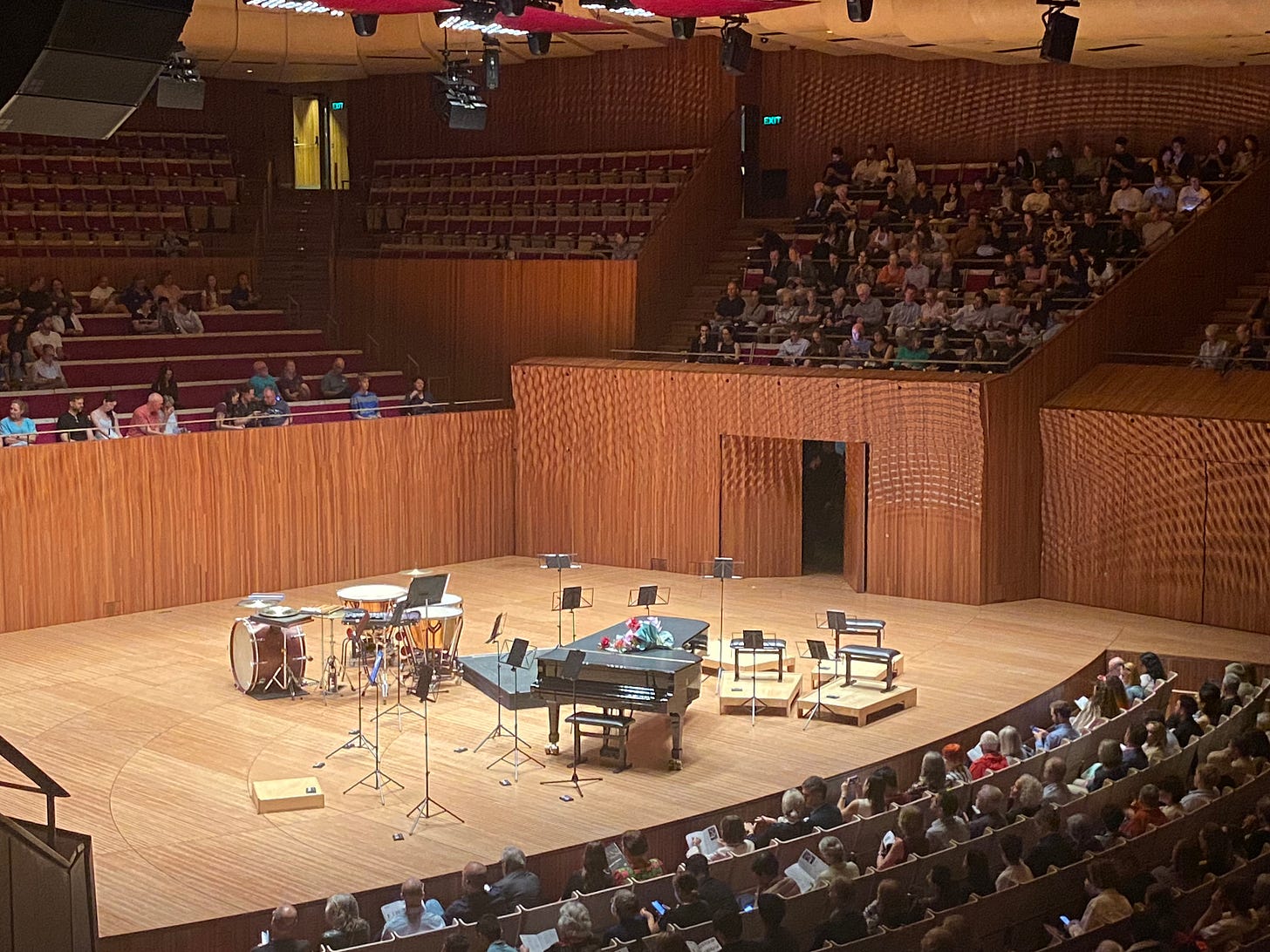
Yesterday Jill and I attended the renowned Australian Chamber Orchestra’s performance at the Sydney Opera House’s concert hall. A Christmas present to Jill that was eagerly anticipated by us both.
We’ve had a tough month moving elderly family into aged care, all the way over in Perth. I’ve also just had surgery on a torn hamstring and haven’t been able to run (let the reading runner understand).
For those who have never visited Australia’s architectural marvel, it contains multiple performance spaces. However the concert hall is the jewel within the jewel that is the Opera House, sitting as it does within the crown of the magnificent harbour.
I have posted many photos on socials of the building itself over the past few years, and have run around it hundreds of times. Our last time here was for a concert on the steps outside by Australian electro-pop maestros, Parcels on a stormy December evening. Sydney sparkled, it was joyous. And it was a week or so before Bondi.

While the exterior of the Opera House is well versed and breath-taking, the renovations of the past five years within have been superb. The stylish modernism with a warm, and rounded softer edge, the neat and immense timber doors, the curve of the seats, all of it is a sensory experience. And improved acoustics! It’s amazing.
Our program was a four-part performance, with various iterations of instruments on the stage, that eventually included the piano for the highlight, Rachmaninoff’s Rhapsody with guest pianist, Dejan Lazic.
The other three pieces were Stravinsky (tense and taut as usual), a world premiere entitled Horizon by John Luther Adams (a moody and lush piece that was, ironically, aorist and seamless), and an Australian premiere, by Lithuanian composer, Raminta Serksnyte, entitled de Profundis – out of the depths (Psalm 130).
It was sublime. Transcendent almost. And indeed that’s the point. And it’s something I have experienced every time that I go to the Opera House to hear and see classical music played by highly talented people on instruments that date back as far as the 1400s. It’s all self-consciously transcendent. It’s meant to be.
And it is transcendence self-consciously located within the immanent frame. And indeed that was the intention of John Luther Adams, as he explained in his extensive show notes. He, as so many of us in the West now know, are experiencing a dark pall over the world. And Sydney is clearly no stranger to this darkness.
Adams, who was in attendance and received a rapturous applause, writes in a piece called “The Liminal Line” (the horizon where earth meets the heavens):
The urgent challenge facing artists and all thinking people today is this: How do we respond to this unprecedented moment in human history? How can we give voice to our grief? How can we move beyond grief to solace? And beyond solace, how can we find our way forward, towards the possibility of redemption?
Leaving aside the fact that this is no unprecedented moment (‘Never Again is Now’ anyone?), the lament is recognisable. Things are getting dark. And we don’t know where to turn. Is redemption even an option in this setting?
Adams offers us music and the arts as the portal by which the sublime, the transcendent, can be reached. And there’s something almost true about that. I felt it yesterday as Rachmaninoff’s famed Variation 18 swelled across the hall, threatening to burst our hearts. (Google this rehearsal of the piece by Daniel Trifinov and count your resting heart rate beginning and end).
Almost true. The sublime is reached for, but somehow fades from our grasp, until we play pieces like that again. To bring it into a more popular musical context, the equally famous song by 1970s rock band Boston “More Than A Feeling” contains this liminal reflection:
I looked out this morning and the sun was gone
Turned on some music to start my day
I lost myself in a familiar song
I closed my eyes and I slipped awayIt’s more than a feeling
(More than a feeling)
When I hear that old song they used to play
(More than a feeling)
I begin dreaming
(More than a feeling)
‘Til I see Marianne walk away
I see my Marianne walkin’ away
Not a feeling. That’s too earthbound. It’s more than a feeling. And music and the thought of love bring this to crescendo, even as the singer recognises it’s all just beyond his reach. Thanks a lot Marianne!
But back to the Opera House. The third piece by Serksnyte, de Profundis, is entitled as such because of Psalm 130. And it too is about the depths of despair and the desire for something to lift this present darkness. The Psalmist exclaims:
Out of the depths have I cried unto thee, O Lord.
Lord, hear my voice: let thine ears be attentive to the voice of my supplications.
If thou, Lord, shouldest mark iniquities, O Lord, who shall stand?
But there is forgiveness with thee, that thou mayest be feared.
I wait for the Lord, my soul doth wait, and in his word do I hope.
My soul waiteth for the Lord more than they that watch for the morning: I say, more than they that watch for the morning.
Let Israel hope in the Lord: for with the Lord there is mercy, and with him is plenteous redemption.
And he shall redeem Israel from all his iniquities.
What believer has not uttered something along these lines – or indeed these very lines – when in the depths. Hope in the midst of despair. Hope in the transcendent God who alone can lift our souls from those depths.
Yet, strikingly, it’s the absence of true transcendence that Serksnyte leans into. In the show notes we read her reasoning for the piece (which was wonderful btw, truly profound):
Serksnyte believes “that peak experience and spiritual impact is the essence of art, which can lead to the unforgettable transcendental experience. Both in art and life, one longs for unusual, transcendent experiences and believes in sacredness in art. Hence the title “from the depths”, although the work does not follow the historical tradition of De Profundis.
Spot the recurring theme? Can art give us the truly transcendent moment we need in order to rise above the depths of despair that we see in the world around us? Are the surly bonds of this earth able to be breached by a liminal musical moment, both its creation and its performance?
The desire for transcendent moments is not exclusive to the Western tradition in the past couple of centuries, but the desire for such an experience solely within the bounds of the immanent frame certainly is.
Much of the Western canon is predicated on the fact that the arts reflect a higher transcendence, that of Creator God. The arts reflect this transcendence, they do not create it.
The emotional experience, whether via Rachmaninoff or Boston, are as the shining on Moses’ face coming down from Sinai – temporary. Liminal spaces though they be, they are fleeting. And that creates a tension that for many, is unsustainable. Just ask any spiralling addict.
In his show notes Adams asked the question “How can we give voice to our grief?” The original de Profundis of Psalm 130 daringly pushes this further and asks “To whom can we give voice to our grief?” Unless our grief can be voiced towards someone beyond ourselves it risks becoming a feedback loop. Yet both Adams and Serksnyte (even more self-consciously), shy away from such conclusions. Their profundity and liminal desires are earth-bound.
And that’s just not enough. It just isn’t. I began the day yesterday as guest preacher for a friend who has suddenly, and most urgently, required surgery and is out of action for at least six weeks. I’m preaching the book of James for his church, entitling the series “Gloriously Humble”. And in my overview/introduction I hinted at these words that kick hard in chapter one:
Blessed is the one who perseveres under trial because, having stood the test, that person will receive the crown of life that the Lord has promised to those who love him. (James 1:12).
The Scriptures assume a transcendence above this world. There is a world beyond the horizon that can be arrived at. The secular arts in the West are constantly seeking a fuller experience of the sublime and the transcendent, but, while they touch the edge of these matters, they cannot push beyond them.
For while they would, if only they could see it, gain something beyond earthly measure in doing so, the risk to personal autonomy that this might bring, is too great for such a leap to be contemplated. So earthbound they must remain. Honest, beautiful, inquiring and visceral, but always and forever earthbound.
The concert finished and we shuffled with the other patrons along the handsome, pebbled concrete to the cacophonous quay, all ferries, tourists and gelato. The transcendent moment finished, or slipped away, as Boston sang.
It started to rain, the humid afternoon turned chilly, and my beautiful Jill, grabbed her new umbrella (a Christmas present from our daughter who had misplaced Jill’s old umbrella).

Where does our hope of anything but eventual despair lie? It must be in a transcendent moment beyond great experiences, or making love, or our dedication to our craft.
When that dread dark day should come, may whichever of us is left in that suddenly emptier bed echo the words of Psalm 130:
I wait for the Lord, my soul doth wait, and in his word do I hope.
My soul waiteth for the Lord more than they that watch for the morning: I say, more than they that watch for the morning.
For there is yet another level of transcendence, a sublime existence, that the art we experienced yesterday can truly, but never fully, reflect. There is a transcendent redemption to be experienced just beyond the horizon of this world towards which all other earth-bound redemptive performances can merely direct us.
Written by


There is no guarantee that Jesus will return in our desired timeframe. Yet we have no reason to be anxious, because even if the timeframe is not guaranteed, the outcome is! We don’t have to waste energy being anxious; we can put it to better use.
Stephen McAlpine – futureproof
Stay in the know
Receive content updates, new blog articles and upcoming events all to your inbox.