
January 28, 2025
Babylon Berlin, Jazz, Church Planting and the New Jerusalem
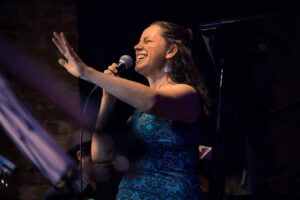
Ali Maegraith sings the Psalms for the Berlin Psalm Projekt
Babylon Berlin
There’s something about music and Berlin, isn’t there? In my view, it was Lou Reed and David Bowie‘s time in that city that led to some of the best music of the 1970s (I listened to in the 1980s and 1990s as a late teen/early twenties).
The live performance by Bowie in Berlin of a song about Berlin (Heroes), is one of my favourite live performances. Ever. Have a watch here.
I, I can remember (I remember)Standing, by the wall (by the wall)And the guns, shot above our heads (over our heads)And we kissed, as though nothing could fall (nothing could fall)And the shame, was on the other side
Those lyrics describe him watching from the hotel window as his friend and producer Tony Visconti illicitly kisses a woman he was having an affair with, by the Berlin Wall. After all, Babylon and Berlin go together don’t they?
Another wonderful Berlin live performance is by Depeche Mode of probably their best song ever, Enjoy The Silence. It’s a decadent, brilliant rendition. And it’s Babylon Berlin once more.
And my most listened to band on Spotify the past two years running, Parcels, are a Byron Bay outfit who moved in toto to Berlin when each band member was just 17 years of age. They’re musical geniuses, and they too tap into that Babylon Berlin vibe. This long studio video was shot in Berlin’s exemplary Hansa Studios. Take the time to watch it later.
Mind you, it’s interesting listening to band members being interviewed about the reason they love Berlin so much. An openness in the city to “lifestyle experimentation” (longhand for sex and drugs) was top of that conversation. Berlin is Babylon is Berlin.
The Berlin Psalm Projekt
So it was with much interest that I accepted tickets to a jazz group that was going to be playing in Sydney not long after we arrived here to live late last year. In fact, the first offer had been to a gig in Perth, but we had just left home and made our way to Ninevah, er Sydney. I cheekily asked if there were to be any gigs in Sydney, and there were!
Which is how I got to sit on my lounge at our new home in Sydney’s Inner West, interviewing Sydney born and bred Richard and Ali Maegraith, the anchor-points of what is the brilliant Berlin-based jazz ensemble The Berlin Psalm Projekt.
Rich and Ali are mild-mannered church planters in Berlin by day, and heroic singers and jazz interpreters of the Psalms by night! Or at least that is how it sounded to me.
I have to say the gig we went to kinda blew us away in terms of sheer quality. With Ali singing, Rich playing a very large oboe (think I’ve got that right), and a gathering of local Sydney talent (and it was high level talent), it opened up the Psalms in a manner I could never have imagined. Something was going on here.
For a start the place was packed. A local jazz club that is not Christian, mixed staff and mixed audience, and a vibe that was just right. I’d recommend Foundry 616 as a venue for atmosphere and the food.
But there was something more. Often we are used to hearing the Psalms played for modern worship in a style that lends itself away from the actual words of the Psalm in question itself.
But to hear Psalm 2 sung and played in a way that foregrounded both the rage of the nations, and the mockery of God at their striving to supplant him, well that was special. Ali’s voice was superb, picking out the emotional path for us to follow. And the music – a bit of free-form, a bit of metered and well rehearsed? I can’t tell as I’m no musician. But we loved it. My 16 year old son landed on Psalm 2 number as his favourite.
By the way have a watch of Psalm 27 below in studio form. Brilliant eh?
But here’s the rub. Unlike Parcels, and unlike Lou Reed and David Bowie, it wasn’t the glamour of the Babylonian side of Berlin that drew Ali and Rich (along with their four sons) to a city that draws hundreds of thousands to it every year. Berlin has become the go-to place for the musicians, artists, bohemians, and yes, druggies, just as it has for a century or more. It was the need. The gospel need.
It was not the desire for music excellence that brought the Maegraiths to Berlin, but the desire for Jesus’ name to be lifted up. For the past decade Ali and Rich have been proclaiming the gospel word in Berlin as well as performing the Psalms in song.
When Babylon Berlin Lets You Down
Rich and Ali and their family are at the centre of a church plant in Berlin, – Rich is the pastor – one of the most secular, spiritually impoverished and “lifestyle experimentation” cities in the West. As they see it, if you can’t find what you’re looking for in Berlin, it probably doesn’t exist.
And in their experience, when people have come to the terminus of their hopes and dreams in Berlin, it’s a short walk from there to despair. They may arrive in Berlin think that Christianity is a strange, olde-worlde vestige of their grandparents’ lives, but in the pain of disappointment some are open to talking about it in a way that they were not before.
For Ali and Rich, they are finding themselves in conversations aplenty about Jesus! The social issues, the angst, longing, disappointments, addictions, heart-aches that were supposed to have been answered by Babylon Berlin, are not answered, or become more deeply embedded.
And this bleeds into their long-term relationships – or more to the point, lack of them. In the school class of one of Ali and Rich’s sons, only two of the thirty students had parents who were married, and many did not even know who one of their parents might be.
“The only two intact marriages in the class were us, and another African family who were also Christian.”
Rich and Ali are planting with European Christian Mission, and their church, Kiez Church Wedding (Wedding being a borough in Berlin) lies in the heartland of those disappointments and addictions. The gloss of Babylon Berlin rubs off quickly in such parts of town.
Like so much of Europe, it’s post-Christian. People are looking for something transcendent, they’re just not necessarily looking at Jesus. Yet as Ali says it’s not even post-Christian, it’s a “post-post-post” situation. She observes:
Even saying you’re married is weird, no one is married. But it’s exciting because there’s a ripeness there. People are feeling the lack of something. I said to Rich here in the Inner West of Sydney [a progressive part of town] look at all these intact families walking around! That’s not Berlin.
Babylon And the New Jerusalem
So how does Babylon Berlin jazz and the New Jerusalem of church go together? Isn’t that just oil and water? Rich and Ali observe how many Aussies, even in Sydney, cannot believe that they would “risk” their family life in such a place. And never mind the social conditions, they live in a cramped quarters (four rooms is not four bedrooms in Berlin, it’s four actual rooms and they Maegraiths have four actual boys!).
So how do they get to know people in that city? For the Maegraiths in this music loving city, Jazz has become an “in” for the gospel and for conversations that might not otherwise be had. Ali says that they don’t hide their Christian light under a bushel. People – especially those in the city’s jazz clubs-, know they are believers and come over to their house to play music together.
Even in that tiny house. I conducted our interview in my wife’s work studio just at the back of our much larger house and Rich – with Ali chiming in her affirmation – waved around at the couches and rugs and said:
There are heaps of house concerts in Berlin. This space here would immediately be transformed into a performance space. You would advertise it underground. You would invite a couple of artists who’d sit in the corner. There’d be spoken word at the events, and that’s often how we’ve used the Scriptures, in a spoken word style with improvised music behind it. Wisdom literature works really well!
The most striking feature of Berlin is the total absence of any Christian framework or even conversation. It’s a challenge for any church in Australia, the US or the UK when people are slightly hostile to the faith, but it’s next level when no one knows anything at all, especially since the fall of the Berlin Wall and the integration of the previously communist East Berlin.
Yet, counter-intuitively this sheer lack often makes people more open, as one couple’s experiences reveal. Here’s Ali:
There’s a beautiful couple in the church who have come to faith in the last few years, and just to hear their stories of ‘no Christian anything’. They were East Berliners, with no one [of faith] in their entire extended family. If you mentioned that someone was a Christian, or that someone’s auntie was a Christian, it meant that they had psychological problems and needed help. That atheist mentality was very deeply entrenched.
As a church planter myself it all sounds a good deal further down the food-chain from my own experience. Here we are in Australia with resources and church planting networks, and it still feels hard. How much harder then, in Berlin.
Yet what struck my about the Maegraiths was a number of key things: their gospel joy, their love of the lost, their commitment to the Word of God being proclaimed, their desire to reach people far, far away from Jesus.
That and their confidence that even their four children in Babylon Berlin can be kept by the God who kept his people in the actual Babylon. They live in a city that has a homeless crisis, and a domestic violence scourge (often a toxic cocktail as an abused woman has nowhere to go given the lack of housing). Yet the gospel shapes their lives.
It may sounds grim at times. But in a positive sign, there are now many church planting efforts in Berlin. There is a transient, immigrant population that moves through the city on a regular basis. It feels like Berlin is a crossroads city. People come there to find themselves. Some of them leave having found Jesus.
Ali brings that reality round to the Berlin Psalm Projekt’s core principles when singing the hymnal of Israel in a city like Berlin:
I just love the fact of God being present in our deepest suffering, and the honesty that we are free to have in that, and that we don’t have to be a certain thing, or say a certain thing, or do a certain thing, but that God comes to us right where we are, in the mess that we are in. He’s not expecting us to jump through hoops.
I love that idea. When it comes to Heroes, it’s the small “h” heroes who perhaps don’t get the headline act, that God is using in day to day ways to bring the gospel to broken people. It’s the small “h” heroes who help set people on the path away from Babylon towards the New Jerusalem.
God is using Rich and Ali Maegraith in a very special way.
If you would like to support them in their church planting work in Berlin via the European Christian Mission, then you can go here to give through that mission agency. They would value the prayers and financial support of their brothers and sisters in other cities, as they bring the gospel to a great city, but a godless city.
Written by


There is no guarantee that Jesus will return in our desired timeframe. Yet we have no reason to be anxious, because even if the timeframe is not guaranteed, the outcome is! We don’t have to waste energy being anxious; we can put it to better use.
Stephen McAlpine – futureproof
Stay in the know
Receive content updates, new blog articles and upcoming events all to your inbox.