
December 11, 2025
Christmas Carols: God’s Reminder That He Has No Plan B
Never waste a good Advent season I say! Never waste the opportunity that this slim time in the church calendar gives us to offer our people – and the watching world – a fully orbed biblical picture of God’s plan to save the world through his covenant relationship with his people Israel.
God has no Plan B. Only a Plan A. But for so many Christians, we forget that. You see, the average carol service at an evangelical church in the West these days is something of an aberration.
For a few brief weeks, a church culture that has often psychologised, therapeutised and individualised the core tenets of the gospel in so much of its music, starts singing deep biblical truths grounded in the “hopes and fears of all the years”.
What hopes? Well the hopes of the covenant people of God that he will send a rescuer to put the world right and usher in justice, that’s what hopes. What fears? That God won’t! The best Christmas carols are just another reminder that God has no Plan B and that every blessing he has ever planned is met and fulfilled in his Christ, the Lord Jesus.
Which means, for our increasingly biblically illiterate churches (never mind the culture), Advent season is a crucial teaching period. A chance to take a deeper dive into what the Bible is actually all about.
During Advent the most seeker-sensitive church that is all about felt-needs, or the most biblically-reductionistic church that cherry-picks its way through the Scriptures looking for proof texts, suddenly get all “biblical theology” as they focus on the key passages in the gospel of Matthew and Luke, that speak of the coming Messiah.
Granted, that will all finish by the 26th December, but I live in hope that for some churches this season may be the start of asking deeper questions about what all that murky stuff in the Old Testament that rarely sees the light of day in most churches, is all about.
There’s a reason those first few chapters in the Gospel accounts are designed to sound so familiar to readers of the Old Testament. It’s because they are the cross-over chapters. They are the bridge, and they’re written to ensure that we get that they are the bridge!
The language used, the format presented, the dovetailing with the prophetic hopes, and the undercurrent of hope, did not spring out of thin air. They are grounded in Israel’s hope and consolation. They are fulfilment theology. And we sing that theology, wittingly or unwittingly every Christmas.
Go through those carols you’ve been singing. See how steeped they are in the language of the Old Testament. The best carol writers knew their Bibles. They knew the end-focus of the promises as yet unfulfilled. And of course the New Testament writers, overwhelmingly Jewish, knew it also.
That’s why we read such promised soaked passages such as this:
Paul, a servant of Christ Jesus, called to be an apostle and set apart for the gospel of God—the gospel he promised beforehand through his prophets in the Holy Scriptures regarding his Son, who as to his earthly life was a descendant of David, and who through the Spirit of holiness was appointed the Son of God in power. Romans 1:1-4a)
The promised gospel (the good news of God’s salvation), now brought to Gentiles who were outside the covenant of Israel, and as Ephesians 2 says, without God and without hope in the world.
But now…
But now…
The Advent season is the celebration of the “but now” of Ephesians 2:
But now in Christ Jesus you who once were far away have been brought near by the blood of Christ.
And of course Ephesians 2 is not about the replacement of one people with another, but of the bringing together of two peoples at odds with each other (Jew and Gentle) in order to create the “one new human” that God has always intended for humanity to be. And to do so in his promised Messiah, the Lord Jesus Christ.
This “bringing together” that we sing of and celebrate at Advent, struck me hard this past week visiting the St Peter’s Catholic Church in Jaffa in Tel Aviv.
There in that ancient port city (the place Jonah fled from in order to refuse God’s global mission, and the same place St Peter was gifted the vision that preceded the start of God’s global mission to Gentiles in Acts 10), the church itself has a timely reminder in striking visual and architectural form.
I walked into the church and was met with three striking pieces of art: First, facing the East was what seemed like an oddly placed set of doors. Then in the middle of the church was this striking pulpit that was shaped like a tree, with trunk and branches. And finally, facing West, was a painting of that famous Acts 10 scene, with Peter protesting the command by God to rise and kill and eat unclean foods.
I’ve added them in here even though my limited tech abilities leave a lot to be desired in terms of formatting!
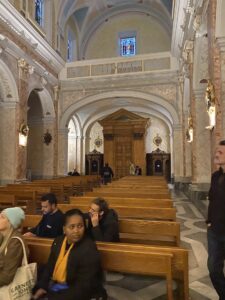
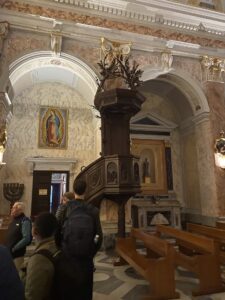
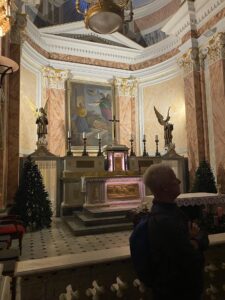
And what’s the point of this architecture and art at St Peter’s on Jaffa (apart from reminding low-evangelical Protestants how they have wasted the opportunity to teach their people theological truths in passive ways by their rejection of architecture as a teaching method)?
It’s the pulpit shaped like a tree in the middle of the church. What sort of tree? Not just any tree. An olive tree! It’s a reminder of Romans 11, and it’s both a warning and a promise:
If some of the branches have been broken off, and you, though a wild olive shoot, have been grafted in among the others and now share in the nourishing sap from the olive root, do not consider yourself to be superior to those other branches. If you do, consider this: you do not support the root, but the root supports you. You will say then, ‘Branches were broken off so that I could be grafted in.’ Granted. But they were broken off because of unbelief, and you stand by faith. Do not be arrogant, but tremble. For if God did not spare the natural branches, he will not spare you either. (Romans 11:17-21)
Right there in St Peter’s Jaffa, the pulpit sits between the East and the temple of God, and the West and the global mission of God. It straddles the hopes expressed and the hopes realised that God is fulfilling his mission.
It announces that the New Testament is not replacing the Old Testament, but fulfilling it. And, more importantly, as Paul reminds the Roman Gentile Christians, they are not the start of God’s Plan B, but the fulfilment of God’s Plan A.
And what’s the point of Romans 11? Don’t fall into the mistake the Old Testament people of God fell into, that somehow their heritage rendered them superior. You’re not. The same sin will result in the same condemnation.
Indeed, it’s harder to graft us in than it will be to see the natural branches restored. Paul can say all of that with blushing. He would make for a terrible modern evangelical.
We would do well to consider St Peter’s Catholic Church in Jaffa and see, in striking visual form, God’s salvation plan for the whole world, planned before time, begun in seed form with his promises to Abraham, and fulfilled in the promised Messiah, the Lord Jesus.
Jaffa launched the grumpy mission to the world via Jonah. It launched the reluctant mission to the world via Peter. Jaffa is proof that God has no Plan B, but only a Plan A that encapsulates every human, indeed all of creation.
And we may not think about that enough, but at Advent we get the chance to sing about it enough. So let’s sing the truths about God’s fulfilment of Plan A with gusto!
Written by


There is no guarantee that Jesus will return in our desired timeframe. Yet we have no reason to be anxious, because even if the timeframe is not guaranteed, the outcome is! We don’t have to waste energy being anxious; we can put it to better use.
Stephen McAlpine – futureproof
Stay in the know
Receive content updates, new blog articles and upcoming events all to your inbox.